Reflections on the 2025 Unicode Technology Workshop
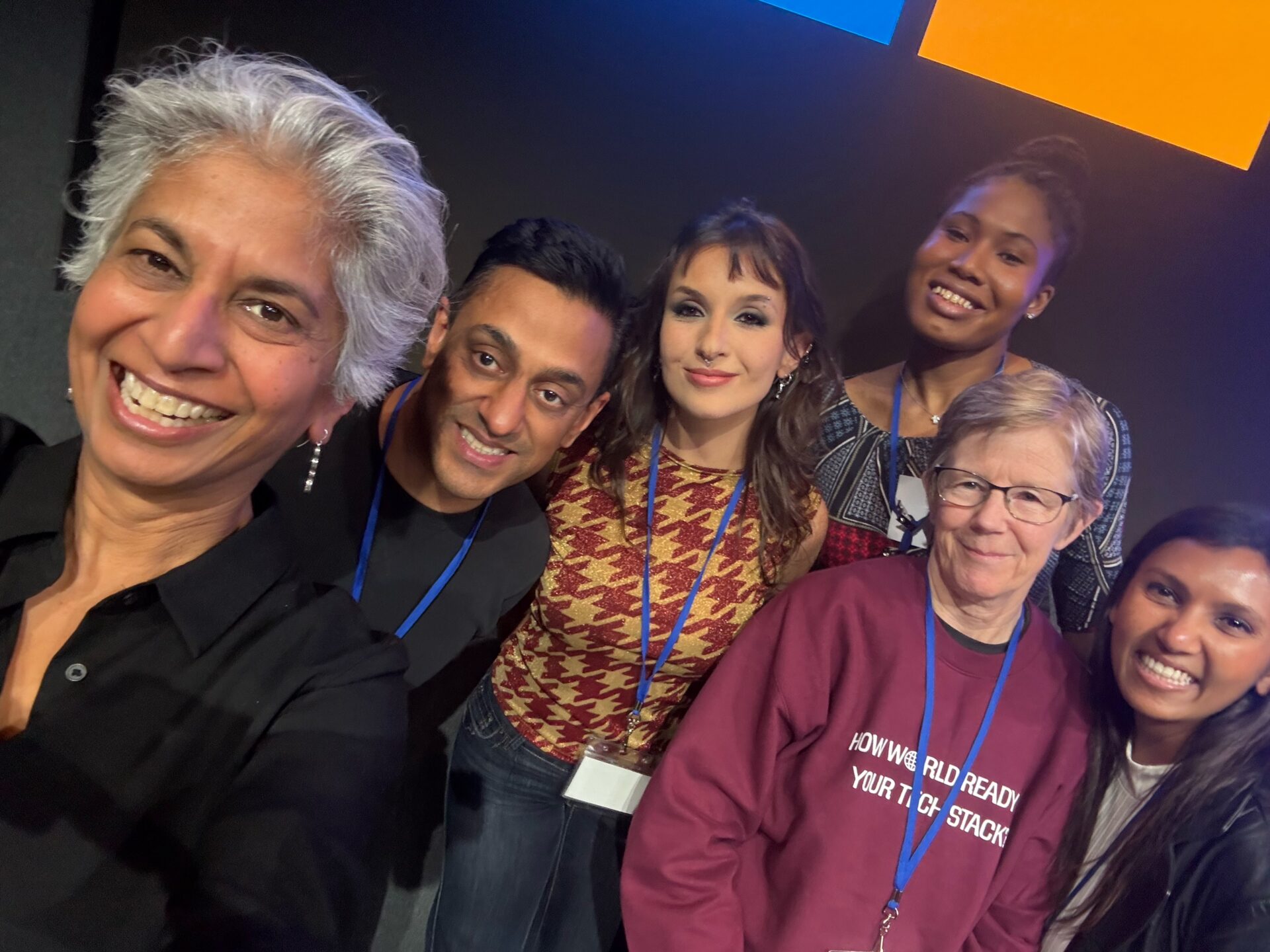
Just over a week ago, many of us from SEI converged in Mountain View, California for the annual Unicode Technology Workshop (UTW). The workshop always draws an interesting mix of implementers, designers, linguists, and wanderers not entirely sure why they are there, but delighted all the same, and this year felt especially lively. For us, it was also the rare moment when all five members of our core team — Helena Kansa, Kyra Ann Dawkins, Anshuman Pandey, Debbie Anderson, and me — were in the same place, which added a nice sense of continuity and a chance to look ahead.
In this post, we’re sharing a reflection on what stood out to us, from the history and structure of UTW to the talks and announcements that closed the week.
What is UTW?
We were struck by how many faces we hadn’t seen before, how many people had flown in from around the world, and how much fun it was to have different generations mix.
Before getting into the highlights, it’s worth taking a moment to understand how we arrived at this particular format of gathering.
UTW is a reimagined relaunch of the earlier Unicode conference that went quiet during the pandemic. The history of the event is revealing.1 To me, it shows who Unicode imagined its core implementer audience to be at different points in time. The earliest “Implementers’ Workshops” in 1991-92 were small, member-organized meetings in the Bay Area that were held just as the Standard was going public.

In 1994, shortly after Unicode and ISO/IEC 10646 merged, joint implementer workshops were held in Santa Clara and Tokyo (East Asian national standards bodies were highly involved in the merger). After that, the gathering settled into a long run as the Internationalization and Unicode Conference (IUC), which ran for 45 editions between 1996 and 2021. Locations once ranged from Hong Kong to Mainz to Dublin, showing an openness to international audiences, but over time consolidated into fifteen consecutive conferences in California – perhaps reflecting some institutional inertia and a narrowing of imagined stakeholders.
When UTW relaunched in 2023, the hope was to broaden the audience and introduce some variation to the event. At first it drew a loyal but modest crowd. To us, this year felt like the turning point. It was exciting to see the conference grow past its die-hard audience. We were struck by how many faces we hadn’t seen before, how many people had flown in from around the world, and how much fun it was to have different generations mix. Unicode Consortium CEO Toral Cowieson noted that this was the biggest edition yet, with 140 attendees across three days of tutorials and talks – nearly a third of which were students.
We also loved the new venue on Microsoft’s campus. Beyond the rooms for talks, it had plenty of nooks for small conversations and inevitable last-minute slideshow edits. There was plenty of natural light, which made the days feel open and lively instead of vacuum-sealed in the usual conference way. Our whole team were big fans of the set-up.


The Program
What about the talks themselves? To be honest, the talks at UTW have always been quite good, and this year stayed true to form – committed to diving into technical topics, with room for different disciplinary insights, and presented in an accessible way. SEI has been a steady presence at various Unicode conferences (you can click through a selection of our past talks on our Research page). But this year we showed up in especially full force, with multiple talks delivered by our network.
One of the first talks on Day 1 was: “Behind the Curtain: The Unicode Technical Committee,” featuring Debbie Anderson alongside other working group chairs. Debbie is known for being the founder and long-time leader of SEI, but for many years also carried the equally demanding role of chairing the Script Ad Hoc (now the Script Encoding Working Group).2She and the other panelists gave a real peek behind the scenes, talking through the cadences of how their respective working groups meet and where their efforts tended to concentrate.

What surprised us was learning that these working groups were actually only formed a few years ago during the pandemic. Before then, most of these discussions happened in long, dense quarterly UTC meetings. When meeting in person became harder, the model shifted: most of the work now happens virtually in designated groups (some meeting as often as twice a week — emoji — and others once a month — scripts), with quarterly read-outs at the UTC meetings. Even for someone who has followed Unicode developments closely, this governance shift hadn’t fully clicked, so it was valuable to hear that background. It was also striking to hear how varied the time commitments were: for some chairs, their day jobs fully absorb these responsibilities; for others, the work happens entirely “after hours,” basically as volunteer labour.
SEI Technical Director and prolific proposal author, Anshuman (or Anshu) Pandey, presented in the afternoon on “Guidelines for Handling Unstandardized and Undeciphered Scripts in Unicode.” His talk gave a deep dive into the Proto-Sinaitic script, which he’s currently preparing to submit to Unicode. Encoding ancient writing raises a whole set of specific concerns: What should the default direction be, when the historical convention was to write in any direction at all? What should the character repertoire include if there are multiple variants of the same sign? Should those variants be handled in fonts, at the encoding layer, or through something like stylistic sets? If scholars called the script various names, what should the title of the code block be?

These are the types of questions that come up in every Unicode submission, but they take on a distinct character for historic scripts. Crucially, you don’t have the original “user community” to consult. Instead, the users are scholars, whose primary aim is to publish texts that include these signs. It’s a different kind of community engagement altogether, and it was fascinating to hear Anshu walk through the specifics for this important script.
After that, Helena Kansa, Kyra Ann Dawkins, and I presented on our process for “Assessing a Script’s Unicode Readiness.” Our aim was to lift the curtain on how we built the readiness rubric on our website and the backend scripts database that supports it. For each “rule” we use to gauge a script’s viability for encoding, we also highlighted examples of exceptions — a way of showing just how messy and idiosyncratic this work can be.


It was fantastic to share this with a room full of collaborators, and we walked away with many ideas for extensions and new applications. It was also great to present as a small, recently-assembled team and to see how naturally we build on each other’s strengths. I left feeling really proud and lucky to be working with my colleagues.
Closing out the SEI afternoon was our recent summer research intern, Karthik Malli, presenting “Capturing Script Dynamism: The Indic Case.” Karthik showed how Indic scripts have been reshaped by earlier text technologies and modern language policy, with many traditional conjuncts simplified into more “transparent” or linear forms.3 One big question that came up afterward was how poised current technologies are to re-introduce some of these more complex forms and which layer of the text stack that responsibility belongs to. It’s an open question, but the discussion led to some great side conversations about how capable OpenType fonts actually are at handling a wide range of writing conventions. It’s a topic we want to keep exploring, and we were glad Karthik brought it to the fore in his talk.

There were many other talks we loved across the conference. Marc Weber from the Computer History Museum gave a wonderful keynote tracing the long history of experiments with character representation. Stephen Morey and Craig Cornelius showed striking examples of the challenges with Southeast Asian scripts, from the persistence of heritage (non-Unicode) fonts to how difficult it still is to access proper fonts on mobile. Andrew Glass gave a fantastic walkthrough of Unicode’s keyboards initiative, which feels like an area to watch. The effort aims to standardize keyboard formats in much the way the OpenType standardized fonts formats in the 1990s, while also using smarter technology to anticipate a user’s keystrokes (echoing ideas pioneered by SIL’s Keyman). And we always love Jennifer Daniel’s emoji updates. She took us from some of the earliest, long-forgotten emoji all the way to the newest additions. A great close to the day.


We loved UTW because it struck such a nice balance between learning and active interaction. We met so many people during the morning speed-networking rounds, and the unconference sessions let us dive into topics that were on our minds (we suggested two sessions: Unicode and the Humanities and Funding & Sustainability).
The post-conference social hours are always the best for bonding. This year we all converged on Ludwig’s Biergarten in downtown Mountain View. A few of us even closed out the bar and met the owner, a Pakistani-German woman whose mother had studied Cuneiform. What are the odds?! You can imagine the overlapping multilingual conversations that followed.




Announcements
There were two big announcements that closed out the conference, and we’ll use them here to close out this post.
First, we joined Toral Cowieson on stage for the big reveal of next year’s UTW conference location: Nancy, France!
This return to Europe after twenty years marks a shift from the long California stretch we noted earlier – a welcome broadening back toward the international audiences the conference once regularly convened. It will be organized by the Unicode Consortium in partnership with our very own Missing Scripts program, a collaboration between the Atelier National de Recherche Typographique, the Institut Designlabor Gutenberg Mainz, and the Script Encoding Initiative. If you read our blog, you probably know the beautiful fonts and posters that have come out of this program. We’ll be hosted in Nancy, just 90 minutes by train from Paris and a perfect mix of old-world artistry and new-world technology.


For us, the exciting opportunity this venue presents is the chance to bring together many people and initiatives that don’t often get to be in the same room. We’re looking forward to curated panels, tough conversations, and creative explorations of Unicode in the world. And of course, we’re thrilled to mark the 10th anniversary of the Missing Scripts project. You won’t want to miss it 😉
More details soon – make sure to follow our socials and sign up for our newsletters to stay up to date.4
And finally, we want to end with one of the true highlights from the week: the Unicode Consortium’s Bulldog Award to Debbie Anderson. As Mark Davis once put it, the award is “to be given to those tenacious champions of Unicode who have produced solid achievements in promoting its use around the globe. This award is called the Bulldog Award; once they bite, they never let go!”
Debbie certainly fits the bill. She has been contributing generously and humbly to Unicode since 2002.5Every person in this space has a story about trying to find their footing in this opaque, slightly intimidating, but fascinating world — and being surprised to receive a warm email from someone sometimes halfway across the globe: Debbie Anderson saying, “Hello! Welcome!” and helping them find their way.


We’re very grateful to Toral for wanting to recognize Debbie’s extraordinary work. And to Debbie, we offer our utmost thanks for building the foundation we stand on today, and for starting the mission of helping the world’s scripts find their place online. It’s an honour to have the chance to carry that work forward.
With that, we hope we’ll see you next year for the next round of UTW in Nancy!
- You can see the full list of past Unicode conferences on the History and Past Conferences pages. ↩︎
- Debbie has since stepped into the role of SEI Director Emerita and continues to serve as the Script Encoding Working Group’s Vice Chair. ↩︎
- You can learn more about Karthik’s research in his recent blog post, “Typewriters, Script, and Modernity in India.” ↩︎
- You can find SEI’s newsletter here and Instagram here, ANRT’s here and here, and the Unicode Consortium’s LinkedIn page here. ↩︎
- Read Debbie’s reflection on her work in our interview with her here. ↩︎